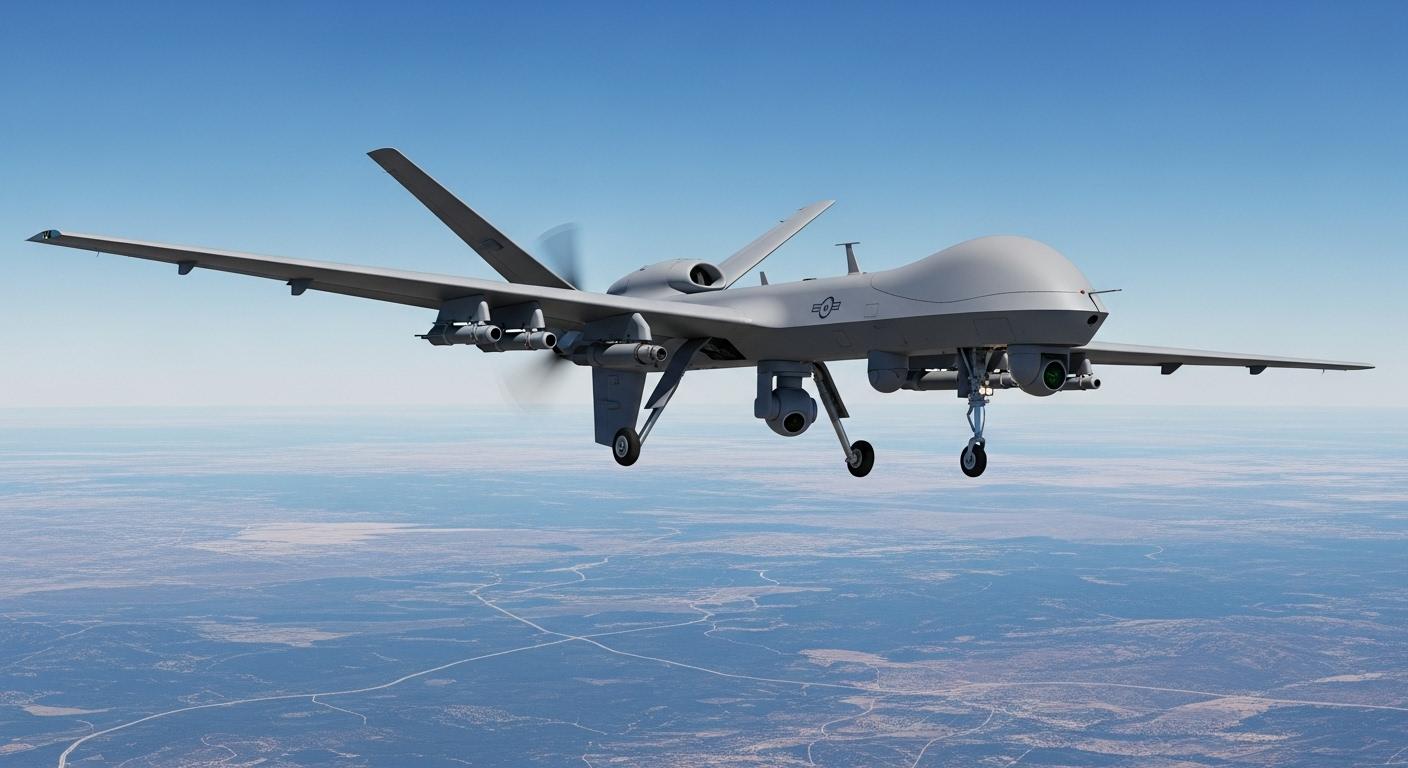
You adjust your perspective as soon as the sky hosts those silent machines that flip the rules of engagement. Military Surveillance Drones do not just observe, they shift the direction of strategy their presence already shapes how armed forces play, and the proof is everywhere. The world adapts to a reality where electronic sentinels unmask threats, redraw borders, and alter power dynamics before your very eyes.
The meteoric rise of Military Surveillance Drones
You walk through military history and notice the transformation that operated almost under cover of darkness. Once, soldiers counted on manned flights that braved hostile zones with no guarantee of return now, unmanned craft creep through the skies, scanning, recording, and quietly dictating tempo. You remember the Predator drone entering the scene in the nineties, its name whispered in the background, and right after, Israel’s Harpy held its own, inviting the world to reconsider its approach to aerial dominance. The bunkers fill with digital screens, not cockpit chatter. Every force adapts, and by the turn of the last decade, miniaturization ensures these drones reach almost every front. No one saw it coming at first: the shift from hesitant use for risky missions, to total reliance. By 2025, that shift becomes concrete, with the French ministry of defense reporting that military UAVs, across all forces, clock more than a billion flight hours in ten years. Today, you realize, the field any field lights up, revealing itself to eyes working far from any noise. For those seeking technical illustrations of this escalation, the specifications and global uptakes await on https://elistair.com/military-surveillance-drones/, where facts fill in the story fast.
The ongoing evolution of military drone technology
Precision reigns, always. The latest UAVs scan license plates from dizzying heights, making evasion a memory. Their encrypted channels, safer than any old vault, transmit clean images, sometimes across oceans. Gone are the scrambled screens and delays operators receive precise intelligence, clear and immediate, without fuss. You sense artificial intelligence creeping in at every turn. Drones analyze, calculate, anticipate. No endless waiting for orders these machines act, ping the human far away only if required. The less human fatigue counts, the fewer errors or breakdowns pop up. You weave through new doctrines where aerodynamic marvels ghost through airspace, undetected by outdated radars. Suddenly, you stumble on a feeling: the search for informational superiority looks unstoppable. Smaller sensors, lighter frames, and an almost supernatural discretion become the new mantra for planners.
| Model | Endurance | Max Payload | Sensors |
|---|---|---|---|
| MQ-9 Reaper | 27 h | 1740 kg | EO/IR, SAR radar, laser detector |
| Heron TP (Israel) | 36 h | 1000 kg | Multimode radar, ELINT, HD imaging |
| CH-4 (China) | 30 h | 345 kg | HD cameras, synthetic aperture radar |
The operational roles of surveillance UAVs
You step past the myth that these machines only observe. Intelligence balloons past simple data gathering the relay of instant images, the warning of imminent threat, all without a pilot in harm’s way. You recognize their reach: border checks, maritime scans, battlefield orchestration. Some models filter tens of thousands of signals every second. Think about French operations in Mali: real-time video feeds steer units away from danger, less exposed, more efficient.
The sky, once empty, now brims with decisive, untiring sentinels
. From combat to disaster scenes, drones morph seamlessly, revealing victims stranded or paths blocked, saving time that no rescue team could spare.
The integration with command and military systems
The push toward shared intelligence feels almost theatrical. Within seconds, your drone’s feed aligns the screens, uniting land, sea, and air elements with one glance. No system adapts to connected warfare faster than these assets. Orders shuffle, jets coordinate, special tactics emerge all depending on the clarity and speed of new airborne data. People dislike the jargon, yet without interoperability, coordination crumbles. You notice one missed transfer sparks cascading failures. Fast reaction rules the new battleground. Drones just click in and spin up the urgency, shrinking the gaps between information and response. The whole space, buzzing with sensors, shifts from fog to pure acceleration. Faster, more connected, but never more unpredictable.
The strengths and obstacles of using military drones
Security, vigilance, endurance uncrewed systems tick all those boxes. Troops keep away from danger while unmanned vehicles scour hundreds of miles, holding station for hours without complaint. Budgets breathe easier as well, since traditional aircraft pale when weighed for cost and endurance. The set-up changes fast swap one sensor for another, adapt the mission in minutes with a keystroke. Accuracy deepens; mishaps decrease. Threats get flagged before they reach the news.
- Lowered risks for soldiers compared to piloted operations
- Heightened flexibility for any scenario
- Reduced expenses for extended operations
- Superior detail in intelligence delivered live
The technical, ethical, and tactical drawbacks
Yet quiet does not mean peace of mind. You watch, sometimes helpless, as vulnerabilities creep in. Hacking, spoofing, jamming the nightmares of any operator. One misstep in the signal chain and the whole mission unravels, information lost, objectives missed. Secured communication burns fuel and shortens time aloft. Electronic warfare remains the trickster, complicating both attack and defense.
Ethics never wait for permission. Who really monitors the monitors? Where does surveillance cross the line into intrusion?
Civil society steps in. Privacy groups press officials. Questions boil over: transparency, airspace, operator accountability. Losing an asset even friendly turf leaves a diplomatic mess, paperwork, investigations. And yes, planners wrack their brains over every new drone lost or hijacked. Solutions drift in, then mutate. The cat-and-mouse rhythm never breaks.
The future directions of Military Surveillance Drones
The future rumbles, full of questions. Tomorrow’s swarms think for themselves, swarm in flocks the human mind cannot direct. You track projects at DARPA, where micro-drones deploy in packs, enveloping enemy bastions, running at impossible speeds. Stealth evolves: reactive surfaces, materials so tricky the radar stops noticing. New batteries stretch the range miles past yesterday’s limit. Some experts already wonder how much autonomy will rule. You picture UAVs breaching enemy zones, no operator anywhere, control vanishing into algorithms. Control shifts; decisions move closer to the edge of the unknown.
The global spread and legal boundaries
No one remains alone in the race you hear that seventy nations already design, develop, and export smart reconnaissance UAVs, and the UN notes the roll keeps growing. The market swells, with China, Turkey, Israel selling next-generation models across borders. Old alliances strain as new buyers enter. Boundaries shift, contractors set up shop. Rivalries multiply. Policies try to follow, but legal frameworks limp behind reality. Europe updates export lists, tries to regulate a trickle that’s now a flood. Traceability, accountability the debates never pause. The question lingers: when every state, and some shadowy actors, own these devices, who gets the final say when rules get hazy?
The comparison of the major surveillance drone models
Models define missions. MQ-9 Reaper pilots fly missions for entire days, carrying payloads that allow unmatched endurance, ideal for ISR and tactical coordination. Heron TP a favorite in Europe impresses with its sophistication and stamina. China’s CH-4 braves desert winds and high peaks, performing with quiet reliability where others might stumble. What connects them all? A constant race for vision, sensor range, and real-time intelligence so every force tailors its choices to unique needs and challenges.
The worldwide adoption of surveillance UAVs
NATO puts its trust in the Reaper during operations far from home. French teams adapt missions in Barkhane by adding Herons to the mix. The mountains of India suit Heron, while the CH-4 secures the Iraqi landscape and keeps Jordan’s borders under careful watch. Tactics evolve, priorities change, but the drive to deploy these tools stays. Every system amplifies a commander’s resolve, never tiring, always parsing chaos for sense. In 2025, the U.S. Department of Defense reveals that sixty percent of intelligence, surveillance, and reconnaissance passes through unmanned sensors proof of the depth of these integrations.
Some nights, you stumble into candid moments. In a dusty Ukrainian camp, Serguey recounts that first time the screens lit up with drone footage: That’s when I felt certain my team moved through less danger. Relief swept the room. Distance, but less anxiety. That mix security tinged with new worries lingers whenever the silent wings pass overhead.
Uncrewed systems slip across frontlines, disturbing yesterday’s balance, folding their logic into global playbooks. You sense both the pull of safety and the chill of constant observation. Where does caution meet intrusion, where does the drive for peace blur with caution? The balance shifts. Under the digital eye, nothing plays by the old rules. What answer do you give when the next move flashes on a screen before anyone on the ground moves?